Newborn Day-Night Confusion: A Sleep Physician's Guide to Flipping the Switch
It is three in the morning, and your baby is wide awake — bright-eyed, alert, ready for the day. Twelve hours earlier, at three in the afternoon, that same baby slept through everything you tried to keep them awake for. If your newborn seems to have their days and nights precisely reversed, you are not imagining it, and you did not cause it. This is one of the most common and most exhausting phases of early newborn life, and it has a clean biological explanation.
As a physician who treats circadian rhythm disorders — the medical conditions that arise when the body's internal clock falls out of step with the outside world — I find newborn day-night confusion oddly familiar. It is the same machinery I work with in adults, only viewed at the very beginning, before the clock has ever been set. Understanding what is happening turns a bewildering problem into a predictable process you can gently work with.
What day-night confusion actually is
Day-night confusion is exactly what it sounds like: a newborn who sleeps for long stretches during the day and is wakeful, alert, and often difficult to settle at night. It is sometimes called reversed sleep or having days and nights mixed up. Crucially, this is not a disorder and not a sign that anything is wrong. It is a stage nearly every newborn passes through, and it resolves on its own as the body clock matures.
The reason is that your baby spent nine months somewhere with no daylight and no darkness. In the womb there is no dawn and no dusk — only a constant environment, with the mother's own rhythms filtering through. A newborn is therefore born without a working sense of day and night, and has to build one from scratch over the first several weeks of life.
This is normal and temporary. Reversed day-night patterns reflect an immature internal clock, not illness or a feeding problem. If your baby is feeding well, having regular wet and dirty diapers, and growing, an unsettled schedule alone is expected. If you are ever unsure, or if the signs below appear, check in with your pediatrician.
Why it happens: a clock with no time set
Deep in the brain, just above where the optic nerves cross, sits a cluster of roughly 20,000 neurons called the suprachiasmatic nucleus (SCN) — the body's master clock. In an adult, the SCN reads light coming through the eyes, releases melatonin as darkness falls, and raises cortisol near dawn, producing a smooth 24-hour rhythm. In a newborn, the SCN is anatomically present but functionally immature: it exists, but it has not yet learned to keep time (Rivkees, Pediatrics, 2003).
Two things have to develop before nights settle. First, the baby has to start producing its own melatonin, the hormone that signals darkness — and that does not begin until around 3 months of age. Second, the cortisol rhythm that helps drive daytime alertness takes about as long to establish. Until both are online, the newborn brain has no internal chemical cue that distinguishes 3 a.m. from 3 p.m. Sleep is simply distributed across the 24-hour day in short bursts, governed by hunger and fatigue rather than by the sun.
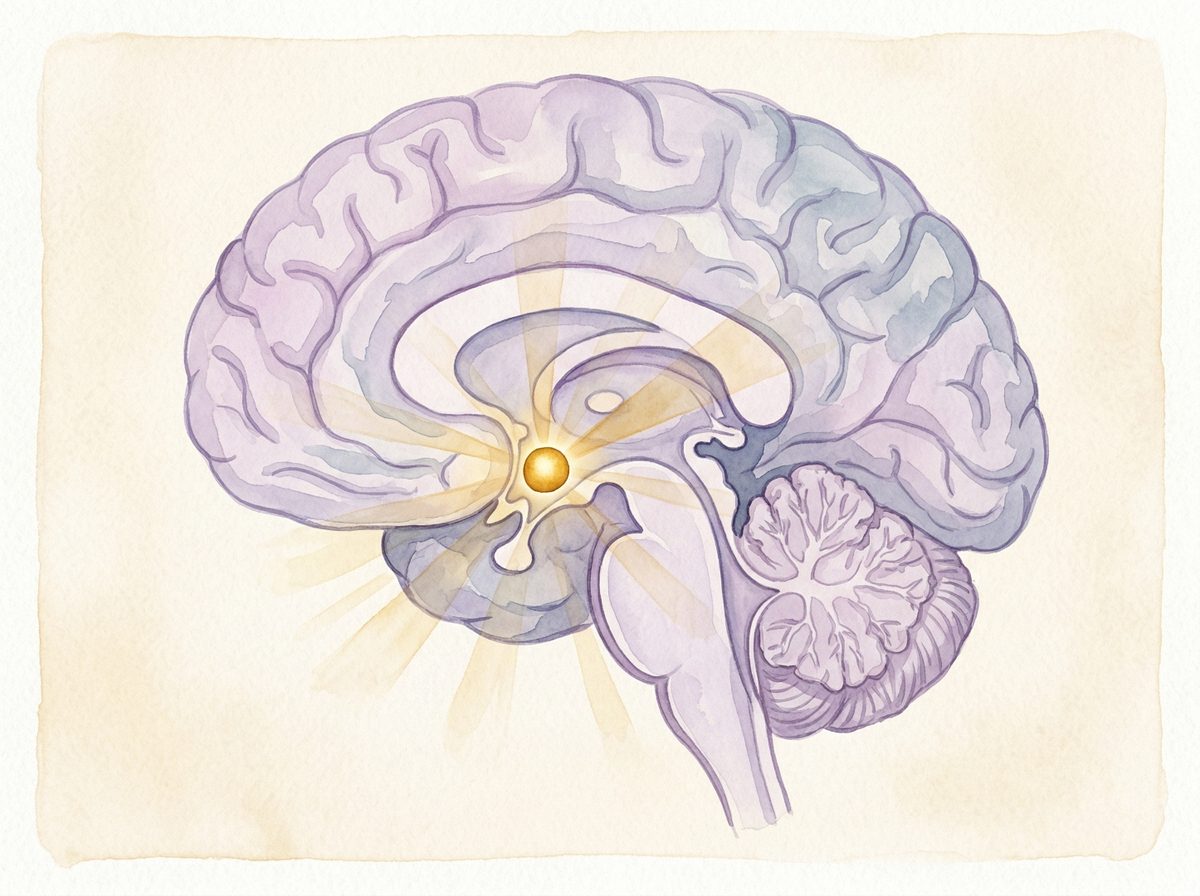
The clock is entrained from the outside — and that is the good news
Here is the part that gives parents something to actually do. A newborn's clock does not set itself in a vacuum. It is entrained — trained onto a 24-hour schedule — by external cues, the strongest of which is light. Research using activity monitors on infants has shown that environmental light is a major driver of the emerging day-night rhythm, and that exposure to a clear cycle of daytime light and nighttime darkness helps the rhythm consolidate over the first several weeks (Yeh et al., European Journal of Pediatrics, 2024). Cycled lighting — bright by day, dark by night — improves nighttime sleep and daytime wakefulness compared with a constant environment.
Before that direct light-entrainment fully takes over, newborns get a second signal from an unexpected source: their mother's milk. Breast milk is not chemically the same at 3 a.m. as it is at 3 p.m. Its melatonin content follows the mother's own circadian rhythm, running near-undetectable during the day and rising to a clear peak after midnight (Haridas et al., Nutrients, 2024). In effect, night milk carries a "this is nighttime" message that day milk does not — a chemical handoff of the mother's clock to a baby who cannot yet make the hormone itself.
A practical note for pumping families. Because milk's melatonin tracks the time it was expressed, milk pumped at night and milk pumped during the day carry different circadian signals. If it fits your routine, labeling expressed milk with the time it was pumped — and offering night-pumped milk at night — keeps that signal pointed the right way. This is a gentle optimization, not a rule; fed is what matters most, and any feeding plan should fit your family and your lactation support.
The timeline: what to expect, week by week
Day-night confusion follows a reasonably predictable arc, tied to the maturation of the circadian system rather than to anything you do or fail to do.
When the internal clock comes online
Each milestone that ends day-night confusion matures over the first few months.
Circadian maturation milestones from the infant sleep-medicine literature.
- Weeks 0–2 — no clock at all. Sleep comes in 2–4 hour blocks scattered randomly around the clock, driven almost entirely by hunger. Reversed days and nights are common and completely expected here.
- Weeks 2–6 — the confusion peaks. The baby is taking in daytime stimulation but cannot yet organize it. This is usually when the reversed pattern feels most relentless. Gentle light-and-dark cues start doing quiet work in the background.
- Weeks 6–12 — the rhythm emerges. A recognizable day-night pattern begins to appear. The longest sleep stretch starts migrating into the night, and daytime wakefulness lengthens. This is the switch beginning to flip.
- Around 3 months — melatonin arrives. The baby begins producing its own melatonin and the cortisol rhythm establishes. Nights consolidate meaningfully, though wakings for feeds continue.
- 3–4 months — a working clock. A genuine circadian rhythm is in place. Day-night confusion, as such, is behind you — even though regular, predictable sleep durations still take longer to arrive.
The levers that actually work, ranked by evidence
Because day-night confusion is a clock-entrainment problem, the interventions that help are the ones that strengthen the contrast between day and night. Here is how I rank them by the strength of the evidence behind them — not by how often they appear on parenting listicles.
Strongest evidence
- Light contrastBright, naturally lit days; dark nights. The single best-supported lever for entraining the infant clock.
- Boring nightsDim light, quiet voice, minimal interaction and no play during night feeds and changes.
- Daytime activityNormal household sound and light during day sleep; do not tiptoe. Contrast is the signal.
Helpful, lower-stakes
- Morning lightA little daylight exposure after waking helps anchor the start of the day.
- Milk timingFor pumping families, night-pumped milk at night preserves the melatonin signal.
- Gentle routineA simple, repeated wind-down sequence at night builds an association over time.
Notice what is not on that list: rigid schedules, keeping a young newborn forcibly awake for long stretches, or anything resembling sleep training. Those either do not work at this age or are inappropriate for a newborn. The levers that work are all variations on one idea — make daytime and nighttime feel unmistakably different, and let the clock do the learning.
What not to do
A few common instincts backfire. Do not black out the house during the day in the hope of forcing sleep — you are erasing the very contrast the clock needs. Do not attempt sleep training in a newborn; structured sleep-training methods are not appropriate before roughly 4 to 6 months, and never in the newborn period. And be cautious with well-meaning advice about caffeine and breastfeeding: moderate maternal caffeine intake is generally considered compatible with breastfeeding, but there is no need to time night feeds around it, and this is a good question for your own lactation consultant or pediatrician rather than a rule to enforce. Above all, do not read a reversed schedule as a failure on your part. It is a developmental stage, not a report card.
Red flags that are not just confusion
Day-night confusion is a scheduling problem, not a health problem — so the warning signs to watch for are the ones that point to something other than an unsettled clock. Contact your pediatrician promptly if wakefulness comes alongside any of these:
- Fever of 100.4°F (38°C) or higher in a baby under 3 months — this always warrants a same-day call.
- Difficulty waking for feeds, unusual floppiness, or a baby who is hard to rouse — the opposite of ordinary night wakefulness.
- Poor feeding or refusing to feed, fewer wet diapers than usual, or signs of dehydration.
- Poor weight gain or a baby not returning to birth weight on the expected timeline.
- Breathing changes, persistent vomiting, or a sudden, marked change from the baby's established pattern.
These are not signs of day-night confusion; they are reasons to be seen. An unsettled schedule in an otherwise thriving, well-feeding baby is not.
How to tell it is working
The switch does not flip in a single night. It shows up first as a trend: the longest continuous sleep stretch slowly migrating from the afternoon into the night, and the longest alert, engaged window drifting into the daytime. That trend is far easier to see when it is written down than when it is lived through in a sleep-deprived fog — a run of scattered wakings can hide a real improvement that is plainly visible once you can look at a week at a glance.
This is exactly the kind of slow, week-over-week shift that Usha Care Guide is built to make visible: log feeds and sleep as they happen, and the pattern reveals itself — the night stretch lengthening, the day waking consolidating — so you can see the clock coming online before it ever feels like it has.
A clock finding its rhythm
Your newborn is not fighting you at 3 a.m. They are running on a clock that has not been set yet — the same clock I spend my clinical days helping adults repair, seen here at its very first calibration. Every bright morning and every dark, boring night is a small nudge that helps it find the rhythm it is designed to keep. The reversal is temporary, the biology is on your side, and the switch does flip.
Sources
- Rivkees SA. Developing circadian rhythmicity in infants. Pediatrics (2003). pubmed.ncbi.nlm.nih.gov/12897290
- Yeh T-C et al. The role of light exposure in infant circadian rhythm establishment: a scoping review. European Journal of Pediatrics (2024). pmc.ncbi.nlm.nih.gov/articles/PMC11685245
- Haridas S et al. Melatonin in Human Breast Milk and Its Potential Role in Circadian Rhythm Development. Nutrients (2024). pmc.ncbi.nlm.nih.gov/articles/PMC11124029
- Thomas KA, Burr RL. Circadian research in mothers and infants: light and maternal influence on infant activity rhythms. pmc.ncbi.nlm.nih.gov/articles/PMC4955618
Medical disclaimer. This article is for general education only and is not medical advice, diagnosis, or treatment. Reading it does not create a physician-patient relationship. I am board-certified in pulmonary and sleep medicine — not a pediatrician or obstetrician — and I write here as a physician and a parent. Always consult your own pediatrician about your baby, and never delay care because of something you read here. If you think your child may be having a medical emergency, call 911. Full details in the site Terms of Use & Medical Disclaimer.