The Newborn Witching Hour: Why Babies Cry at Dusk — and Why It Isn't Colic
Every evening, somewhere around dinnertime, an otherwise healthy newborn begins to cry — hard, long, and seemingly without reason. Feeding doesn't fix it. A clean diaper doesn't fix it. Being held doesn't fix it. For generations, families have reached for the same explanation: colic. Something must be wrong with the baby's stomach, or the milk, or the way the baby is being cared for.
As a sleep physician — and a dad who has paced a dim kitchen at dusk with a crying baby — I want to offer a better explanation. The evening crying window that parents call the witching hour is not a digestive disease, and in most healthy babies it is not a sign that anything is wrong at all. It is a predictable, temporary, and well-documented stage of brain development. Understanding what is actually happening changes how those evenings feel.
What the witching hour is
What families experience each evening has two names. Pediatricians call it the witching hour — a colloquial term for the nightly window of inconsolable fussiness that occurs around dusk. Researchers call it PURPLE crying, an acronym developed by the National Center on Shaken Baby Syndrome's Period of PURPLE Crying program to help parents understand this normal developmental phase:
- P — Peak. Crying peaks around 6–8 weeks of age, then declines.
- U — Unexpected. Crying comes and goes with no clear reason.
- R — Resists soothing. The baby may not stop crying no matter what you do.
- P — Pain-like face. The baby looks like they are in pain, even though they are not.
- L — Long-lasting. Crying can last hours at a time.
- E — Evening. Crying is concentrated in the late afternoon and evening.
The typical pattern is remarkably consistent: it begins around 2 weeks of age, starts nightly at dusk, lasts roughly 3–4 hours, and features high-pitched crying, back arching, and resistance to soothing. Afterward, the baby often sleeps well the rest of the night — and daytime behavior is unremarkable, with normal feeding and sleeping. That evening-specific timing is the tell. A sick baby is sick all day. A witching-hour baby is fine at ten in the morning and inconsolable at seven in the evening.
This is not pain or illness. If a pediatrician has examined your baby and ruled out medical causes, the witching hour is a well-known, normal phenomenon. The crying looks alarming, but it is a sign of a brain that is actively maturing — not a sign of distress or an unmet need. If you have not yet checked in with your pediatrician, do so before assuming the cause.
Why it happens: the body clock is still waking up
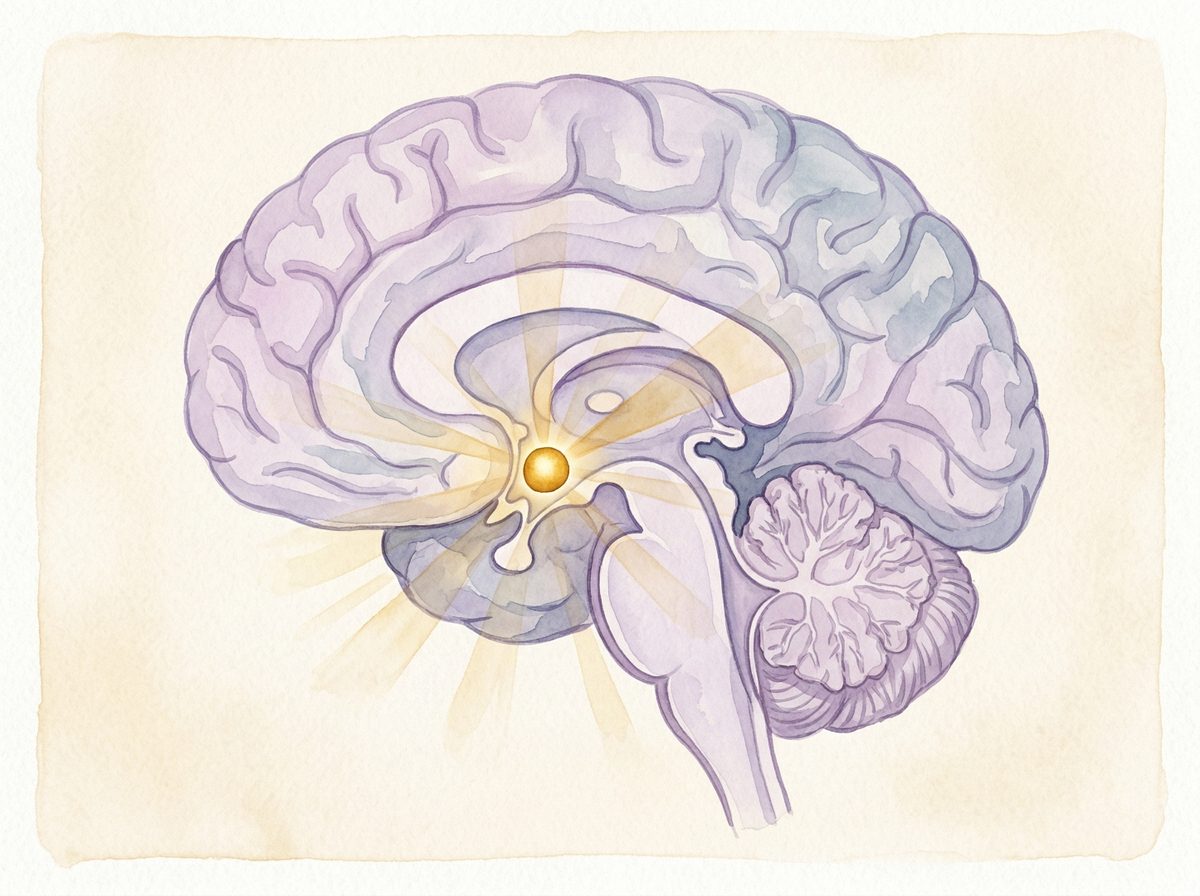
Deep inside the brain, just above where the optic nerves cross, sits a cluster of about 20,000 neurons called the suprachiasmatic nucleus (SCN). This is the body's master clock. In adults, the SCN orchestrates the release of melatonin at dusk and cortisol at dawn, giving us a smooth, predictable daily rhythm.
In newborns, the SCN is anatomically present but functionally immature. It exists, but it hasn't learned to keep time yet. Newborns don't produce their own melatonin until around 3 months of age, and a mature cortisol rhythm takes about as long (Rivkees, Pediatrics, 2003). Without those internal signals, the newborn brain has no chemical cue that distinguishes dusk from any other time of day. The falling light creates a mismatch between the world's cues and the baby's unfinished internal clock — and dusk becomes a vulnerable window of dysregulation. The same not-yet-set clock is also behind newborn day-night confusion — the reversed schedule where a baby sleeps all day and is wide awake at night.
Two bookends of the same clock
Here is the observation I find most clarifying, drawn from the other end of my clinical work. You may have heard of sundowning — when elderly individuals with dementia become agitated, confused, and restless specifically at dusk (National Institute on Aging). The mechanism is strikingly similar: in those patients, the SCN has deteriorated through age-related cell loss. In a newborn, the SCN simply hasn't matured yet. Same clock, opposite bookends of life — both struggling with the same transition, the handoff from day to night.
Newborn
- SCN statusFormed but functionally immature
- MelatoninNot yet self-producing; begins ~3 months
- CortisolFlat daily rhythm; matures ~3 months
- Circadian rhythmAbsent until 6–12 weeks
- TimingDusk fussiness; peaks ~6–8 weeks
- OutcomeSelf-resolves by 3–4 months
Elderly (sundowning)
- SCN statusDeteriorated by cell loss and plaques
- MelatoninDiminished amplitude; phase-delayed
- CortisolDysregulated, flattened daily variation
- Circadian rhythmPresent but degraded and phase-delayed
- TimingDusk agitation; progressive over time
- OutcomeDoes not self-resolve
The parallel is also deeply reassuring. Sundowning results from neurodegeneration and does not self-resolve. A newborn's evening fussiness comes from an SCN that is actively building itself. Once melatonin production begins around 3 months and the cortisol rhythm establishes, the dusk transition smooths out naturally — without any intervention.
The timeline: it follows a predictable arc
Infant crying follows a well-described curve, first characterized in classic studies of healthy infants (Barr, Developmental Medicine & Child Neurology, 1990): crying rises from about 2 weeks, peaks in the second month, and declines steadily thereafter.
The infant crying curve
It rises, it peaks, and then it gets better — on a schedule.
Brazelton (1962) and Barr (1990) — average hours of crying per day across healthy infants.
Internal clock development
Each system that ends the witching hour matures over the first four months.
Circadian maturation milestones from the pediatric sleep-medicine literature.
- 2–3 weeks — onset. Evening fussiness begins as the nervous system starts processing daytime stimulation but cannot yet self-regulate at dusk.
- 6–8 weeks — peak. The most intense period, and the turning point. After this, things begin to improve.
- 6–12 weeks — emerging rhythm. The SCN starts establishing recognizable day-night patterns; sleep becomes slightly more predictable, with longer stretches at night.
- Around 3 months — resolution. Melatonin production begins and the cortisol rhythm establishes. Evening fussiness resolves — coinciding almost exactly with the end of the "fourth trimester."
- 3–4 months — complete. A functioning circadian system, predictable sleep-wake cycles, and smooth day-to-night transitions. By this point, the witching hour is typically a memory.
What actually helps
Because the cause is neurological rather than digestive, no soothing technique reliably "fixes" the witching hour — and that is expected, not a failure. Gentle, low-stimulation soothing helps you and your baby ride it out together: dim lights, a calm voice, swaddling if your baby likes it, motion (rocking, walking, a baby carrier), white noise, a pacifier, and skin-to-skin contact (Cleveland Clinic). None of these always work. The goal is to get through the window, not to end it.
One caregiving note matters more than any technique: this phase is the single most common trigger for caregiver frustration, which is why the PURPLE framework was created by a shaken-baby-prevention organization in the first place. If you feel yourself reaching a breaking point, put the baby down in a safe place, step away, and take a few minutes to breathe. A few more minutes of crying will not harm your baby. Handing off between caregivers on alternating evenings — a partner, a grandparent, anyone in the circle — is one of the most effective strategies there is. The split-night system extends that same idea to the whole night, so both parents still get a real block of sleep.
When to call the pediatrician
Crying alone, at this age and in this pattern, is not a worrying sign. Seek care promptly if crying comes with fever (100.4°F / 38°C or higher), poor feeding or refusing to eat for more than eight hours, vomiting, unusual lethargy, breathing changes, poor weight gain, crying that worsens when the baby is moved or touched, or a sudden change in the established pattern (Cleveland Clinic).
One acoustic clue is worth knowing. Cry research using machine-learning analysis found that colic-type cries acoustically resemble pain cries in pitch and intensity — which is exactly why witching-hour crying sounds so alarming even when nothing is wrong (Parga et al., Pediatric Research, 2019).
Acoustic studies place infant cries along this spectrum. Notably, colic and PURPLE crying sit at the far, high-intensity end — acoustically almost indistinguishable from a pain cry, even though the crying itself is developmentally normal.
The practical red flag is a new, sudden upward pitch shift with sustained intensity that resists all usual soothing, especially outside the typical evening window. When that happens, do a quick check: temperature, a hair wrapped around a finger or toe, signs of injury, recent feeds — and call your pediatrician if anything seems off.
Questions grandparents often ask
Is the baby in pain? No. Although the crying looks like a pain reaction, the literature is clear that PURPLE crying is not caused by pain or illness. The pain-like face is part of how a developing nervous system expresses dysregulation — not a signal of harm.
Is something wrong with the way the baby is being cared for? No. The witching hour appears in well-fed, well-loved, well-cared-for babies across cultures. It is a developmental phase, not a parenting problem. Trying many things and having nothing work is part of the textbook description.
Should the baby see a doctor? A baby who is followed by a pediatrician, growing well, and fussy only in the evening window fits the normal pattern. Watch for the genuinely worrying signs above and seek care immediately if any appear.
Will this cause sleep problems later? No. The witching hour and later sleep patterns are unrelated. Babies with intense witching-hour periods do not sleep worse as toddlers or older children.
This is a brain learning to tell time
Every evening that feels hard right now is a circadian system building itself. The same clock that causes this temporary fussiness will soon deliver peaceful, predictable nights — for the baby, and for everyone who loves them. The witching hour is not something your family is doing wrong. It is something your baby's brain is doing right, on schedule, and it ends.
Related reading: Newborn Day-Night Confusion: A Sleep Physician's Guide to Flipping the Switch — the same developing clock, seen across the whole 24 hours: why newborns mix up day and night, and the light-and-contrast levers that gently set the rhythm. And for the adults: The Split-Night System — a physician's shift schedule so both parents get five hours of real sleep during these weeks. When you want to raise the crying pattern with your pediatrician, What to Ask at Every Well-Child Visit has the five questions worth asking at each visit from birth to 15 months.
Sources
- Barr RG. The normal crying curve: what do we really know? Developmental Medicine & Child Neurology (1990). pubmed.ncbi.nlm.nih.gov/2332126
- Rivkees SA. Developing circadian rhythmicity in infants. Pediatrics (2003). pubmed.ncbi.nlm.nih.gov/12897290
- Parga JJ et al. Defining and distinguishing infant behavioral states using acoustic cry analysis: is colic painful? Pediatric Research (2019). nature.com/articles/s41390-019-0592-4
- National Center on Shaken Baby Syndrome. The Period of PURPLE Crying. purplecrying.info
- Cleveland Clinic. Purple Crying: Symptoms, Causes & Treatment. my.clevelandclinic.org/health/articles/purple-crying
- National Institute on Aging. Coping With Agitation, Aggression, and Sundowning in Alzheimer's Disease. nia.nih.gov
Medical disclaimer. This article is for general education only and is not medical advice, diagnosis, or treatment. Reading it does not create a physician-patient relationship. I am board-certified in pulmonary and sleep medicine — not a pediatrician or obstetrician — and I write here as a physician and a parent. Always consult your own pediatrician about your baby, and never delay care because of something you read here. If you think your child may be having a medical emergency, call 911. Full details in the site Terms of Use & Medical Disclaimer.